Social Systems and Culture in Therapy
I wrote this reflective essay for our theory and practice class at the University of Rochester. The professor asked us to reflect after learning about systemic, multicultural, and integrative approaches to therapy.
Reflective Essay 2
This essay critically reflects on my learnings from Module 2, which introduced systemic, multicultural, and integrative approaches to therapy.
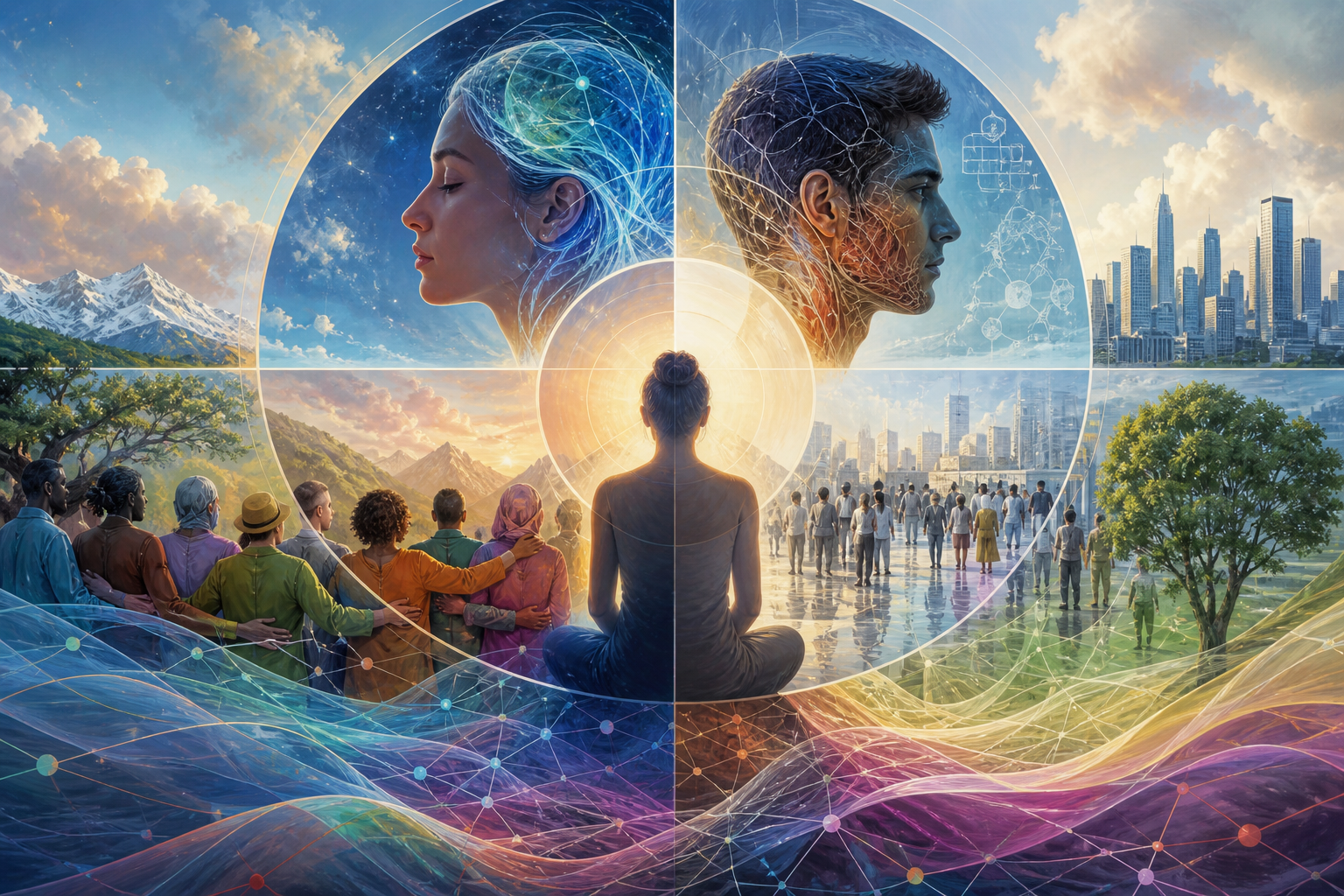
First, I reflect on systemic approaches to therapy as presented within an integrative frame by Marquis (2018, pp. 49–72). Marquis argues that people are complex, multi-dimensional, yet unified; our theory should be too. Integral Theory is introduced as a unifying metatheory, using an “All-Quadrants, All-Levels” (AQAL) model which includes the individual subjective (upper left), individual objective (upper right), collective subjective (lower left), and collective objective (lower right) dimensions. Integral Theory also includes a developmental model and a theory of self. Marquis (2018, pp. 154–178) also presents the Integral Intake as a practical assessment tool that enables clinicians to evaluate clients holistically across these multiple domains.
Reflecting on these ideas, I had some questions. If a human being were in a state of nature, with a small tribe, how would lower quadrants impact psychopathology? How is this different from “civilization”, where governance arises? Based on these readings, class discussions, and experiences, I am striving to develop an integral therapy approach that is also aware of the significance of culture and human development, and the importance of adapting interventions to these variables.
Secondly, I wish to reflect on our learnings regarding multicultural therapy. Soto (2024) looks at multicultural counseling from a practical standpoint, stating that culture is everywhere in therapy and demanding that therapists must become multiculturally competent (MCC). Soto argues that theories need to be updated before being applied to the client’s culture. Leong (2024) took more of a theoretical lens to multicultural counseling. Leong begins by stating that no two clients are the same. He introduces his overarching tripartite model, which suggests that each person is made up of unique personal traits, cultural traits, and universally human traits. Leong argues that a multicultural counselor needs to assess therapy frameworks for multicultural validity and tailor them to cultures using cultural validity approaches.
Reflecting on these papers, I felt left with one essential question: Should we focus on the differences between humans or the similarities? Philosophically, after Kant, two schools of thought seemed to develop, one lineage, via Schopenhauer, Kierkegaard, and Nietzsche, that emphasizes universality and individuality, and the idea of “Other” as transcendental. The other school of thought, via Hegel into Marx, focuses on the differences between humans as primary, with Hegel’s dialectic, Marx’s objective scientific materialism, and the “Other” as the opposing group, the antithesis, with spirit unfolding via teleological synthesis.
In my therapeutic approach, I try to comprehend whether my client identifies themselves by an extrinsic label such as sex, gender, race, nationality, religion, or political party. Or do they define themselves otherwise? My emerging approach as a therapist uses the therapeutic alliance as central. I strive to be flexible and responsive to my client rather than rigid and prescriptive. Interventions should be selected based on real-time client needs, not fixed based on a diagnosis. I see it as my responsibility to learn as much as I can about the culture behind every label, yet humbly recognize I can never know the unique experience of my client.
Finally, I wish to refer to our learnings about integrative therapy. Marquis (2018, pp. 73–113) argues that human development, whilst non-linear and complex, has universal qualities and is central to therapy. Marquis defines psychopathology as failure at one or more points of development. Marquis (2018, pp. 179–209) then describes Integral Theory’s attempt to unify all schools of therapy into one central framework, including the use of “AQAL”. Marquis describes how matching the appropriate technique to the client's state is imperative.
Reflecting on integral therapy, I can admire the importance of unification across the field. I can intuitively see how much more could be achieved if disparate fields could work together. I do question, do humans have a universal developmental path? When I look at animals or plants, I wonder what it would look like to have a developmental path for the perfect horse or the perfect rose? I also wonder, when I consider McLuhan’s famous idea that “The medium is the message”, then any kind of developmental theory needs to be built in a biased medium. What if we tried to define human development by another medium, say, interpretive dance? Music? Painting? Memes? Or even in binary data?
A key strength of my emerging approach as a therapist is its flexibility and ability to adapt to diverse clients and contexts, particularly those from different cultural backgrounds. I see supervision as a crucial element to develop practical skills and judgment so one can engage meaningfully with clients.
In conclusion, I appreciated the learning provided in Module 2 covering systemic, multicultural, and integrative approaches to therapy. Systemic therapies helped me understand the role of culture and society within therapy, and made me reflect on civilization versus a state of nature. Multicultural therapies allowed me to see that a human being is more than an individual, with group and universal affiliations. I was left pondering whether more focus should be placed on our similarities or differences. Finally, looking at integral therapy, I admired the effort to unify fields of therapy and see it as a noble goal; I questioned whether this goal is possible due to constraints and biases in any medium of communication.
References
Marquis, A. (2018). Integral psychotherapy: A unifying approach. Routledge.
Leong, F. T. L. (2024). Cross-cultural theories in psychotherapy. In F. T. L. Leong (Ed.), APA handbook of psychotherapy: Vol. 2. Evidence-based practice, practice-based evidence, and contextual participant-driven practice. American Psychological Association.
Soto, A. (2024). Can psychotherapies be effectively adapted to cultural identity (fit)? In F. T. L. Leong (Ed.), APA handbook of psychotherapy: Vol. 2. Evidence-based practice, practice-based evidence, and contextual participant-driven practice. American Psychological Association. https://doi.org/10.1037/0000354-006
