From Mastery to Genius: Reflections on Carl Rogers and Counseling Theory
I wrote this reflective essay for our theory and practice class at the University of Rochester. The professor asked us to reflect after learning about some ways a counselor can leverage theoretical content. I have included my reflection below.
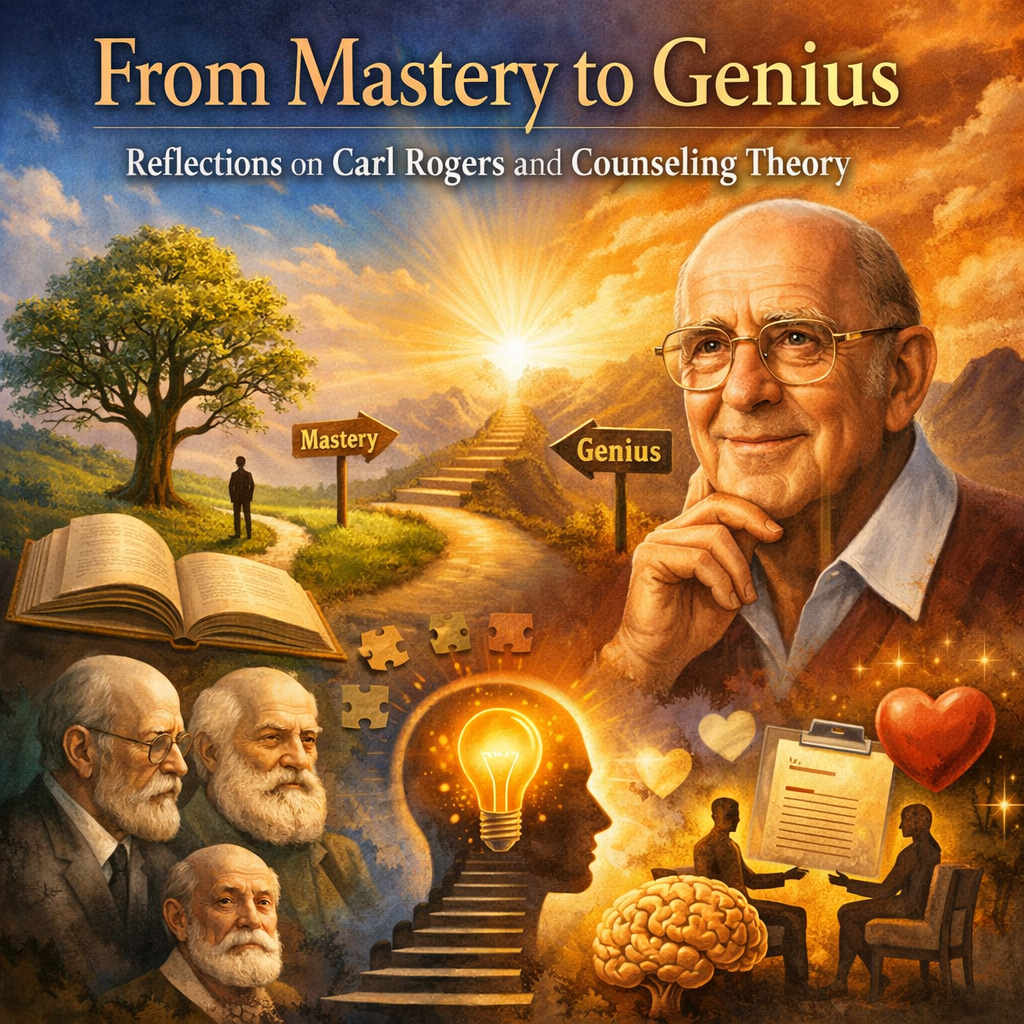
Reflective Essay 1
This essay critically reflects on my learnings from Module 1: Foundational Issues in Counseling Theory and Practice. It is a personal exploration of different ways of conceptualizing human nature and, subsequently, how we can ameliorate human suffering. It draws from diverse inspiration across our Module 1 learnings. Specifically, it focuses on our readings from Chapter 1 (“Introduction”) and Chapter 6 (“Client-Centered Counseling”) in Theoretical Models of Counseling and Psychotherapy (Fall, Holden, & Marquis, 2017).
Chapter 1 of Theoretical Models of Counseling and Psychotherapy starts at the very beginning: how does one conduct their first therapy session? Fall, Holden, and Marquis (2017) argue that beginning counselors are best served by adopting a single theoretical approach. The authors argue that theory serves as an essential guidebook for new counselors, reminding us that there is no single central theory in psychology. Each theory covers different perspectives in the field, so we are left to choose one. The authors then introduce the concept of a "unifying meta-theory," which seeks to join all theories together. Nonetheless, the authors caution that new counselors should first achieve mastery in one theory before attempting to use a multi-theory or meta-theory approach.
Fall, Holden, and Marquis (2017) argue that the best way for a new counselor to choose their guiding theory is to follow their own pre-existing beliefs. For example, a counselor might ask: Do I believe humans are good or evil? How much do I think we attribute to the environment for development and personality? What do I think "healthy" looks like? By clarifying these beliefs, the counselor can choose a theoretical orientation that matches their own identity. If a counselor begins learning a theory and it does not fit with their beliefs, they should change it. In addition, Chapter 1 then highlights other key issues in the field of psychology, like recent discoveries, nature vs nurture, diagnosis, pharmacology, insurance, technical eclecticism, diversity, and psychotherapy effectiveness.
Exploring these ideas, I believe one should follow an existing theory, or at least work in an environment with a supervisor who practices in a way supported by evidence of past success, in order to master established approaches to therapy. However, I recall a well-known paraphrase of Schopenhauer’s ideas on genius: "Talent hits a target no one else can hit; Genius hits a target no one else can see.", which makes me think that if one’s goal is to become a talented counselor, then following an existing theory is solid advice.
However, once someone has mastered a particular theoretical approach, they may want to take the next step, beyond mastery, into “genius”, which involves creating brand new methods. We can see innovative thinkers such as Freud, Rogers, or Pavlov, or even Darwin or Socrates. These thinkers did more than master an existing theory, they created a whole new paradigm for conceptualizing human nature and ameliorating human suffering. In that case, thinkers like this needed to act in a brand new way that no one has documented as a theory. From that new action, a paradigm emerges, and later others may record it as a new theory. If you want to be talented, adopt a theory; but once you’ve mastered a theory, act in creative and new ways in order move from master to genius. Theories describe the past; new actions shape the present and create the future.
Chapter 6 then looks at Client-Centered counseling as both an initial theory and a set of basic skills that counselors can apply across all theoretical modalities. Fall, Holden, and Marquis (2017) give a brief biography of Carl Rogers, the founder of humanistic psychology, also known as client-centered or person-centered psychology. Rogers' story includes growing up with a Western and Christian worldview in a time of societal change and hardship, through world wars, the Great Depression, and the civil rights movements. Rogers' key ideas are that man is good so long as society gets out of his way and that each human has a natural positive actualizing tendency. This tendency is shaped by experience and then governed by our own self-concept.
For Rogers, a healthy person was someone who was congruent, that is that they have developed a self-concept that allows them to be free of all defenses and denials, and to exist without fear, a need for control, and a desire to act in the present moment. Probably the most memorable of Rogers' ideas is that if someone is not in congruence, they can return to their natural, healthy self by being in an environment that lets them experience three key things: unconditional positive regard, empathy, and genuineness. Rogers saw the therapist's role as someone to provide this environment and no more, and with this, a client needs only their own willingness to do the rest.
Reflecting on Roger’s approach, I place him in the camp of a genius rather than merely talented. He discarded theories of his time and focused on studying broadly but also acting relentlessly. From this, he synthesized a whole new approach through his actions. Rogers lived in a climate of war, depression, and civil rights, with a backdrop of rigid moral views, that he felt needed change. Rogers also struggled with alcohol use and occasionally responded harshly to others, contradicting his own idealized views of how one should act. His idealized congruence was the one thing he could never really achieve personally.
Roger's view of human nature is useful so long as people can practically adopt it in the reduction of suffering. In this case, it seems to me that Rogers' theories are not describing human nature, but maybe a climate within nature, a climate of the Western, individualistic, 20th century. Moreover, like any climate, it will have a development pathway of emergence. Systems, philosophies, and civilizations have a life cycle. The longer a worldview or paradigmatic approach continues depends on how encompassing and flexible it is. Yet, if it becomes too encompassing and flexible, it lacks the solid ground necessary to support ideological structures. Balance must be found. If humanistic psychology is rooted in the cultural climate of Western, individualistic, 20th-century morality, its usefulness may be limited to that cultural epoch.
In summary, Chapter 1 from Fall, Holden and Marquis encouraged a beginner therapist to adopt a theory and then introduced the advanced concept of meta-theories. Chapter 6 introduced the theory of client-centered (or humanistic, or person-centered) psychology, prompted by Carl Rogers. My view is that if someone wants to be learm, they should indeed follow a theory, yet if someone has mastered a theory, they should then aspire to “genius” which requires breaking from theory and acting in new, never-before-seen ways.
References
Fall, K. A., Holden, J. M., & Marquis, A. (2017). Theoretical models of counseling and psychotherapy (4th ed.). Routledge.
